Zambia: A Burgeoning Energy Investment Frontier

Zambia is assertively positioning itself as a premier investment hub in Southern Africa. Through strategic pro-business reforms, macroeconomic stabilization, and utilization of its abundant natural resources, an ambitious economic growth story is well underway.
Economic growth is unattainable without a stable and expansive energy sector, while significant strides have been made in Zambia’s energy sector only half its population is connected to the grid. This challenge presents a market waiting to be developed.
Reliable power supply and robust infrastructure is key in mining operations that vastly contribute to gross domestic product, tax revenues, and export earnings. Furthermore, broader industrialization and modern commerce rely on continuous, reliable power. Expanding the energy grid facilitates value-added manufacturing, supply chain scaling, and mechanized agriculture.
The rude wake-up call came when the devastating 2024 drought exposed the country's Achilles' heel: an overwhelming 80% dependence on hydroelectric power. As climate change intensifies weather extremes, Zambia's energy security hangs in precarious balance.
This vulnerability has created a perfect storm (no pun intended) for much needed energy sector growth and investment. Notable policy shifts favour renewable energy investments, with tax incentives and streamlined approval processes designed to attract foreign capital. Zambia's first green bonds, issued in 2023, signaled serious intent to fund the country's energy transformation. For investors, the calculus is rather straightforward; a nation with rising industrial output ambitions, increasing urbanization, and enthusiastic development goals that cannot be achieved without solving its energy needs.
A stand out policy to meet these needs is the Electricity Regulations, 2024 (Open Access Regulations). Historically, generation and transmission was strictly controlled by the state-owned Zambia Electricity Supply Corporation Limited (ZESCO) Open Access allows independent power producers (IPPs) to generate electricity and sell it directly to consumers or trade it over the grid. The bold transition to an open access regime is fundamentally imperative to resolving energy deficits while mobilizing private capital. This move seeks to catalyse competition and operational efficiency.
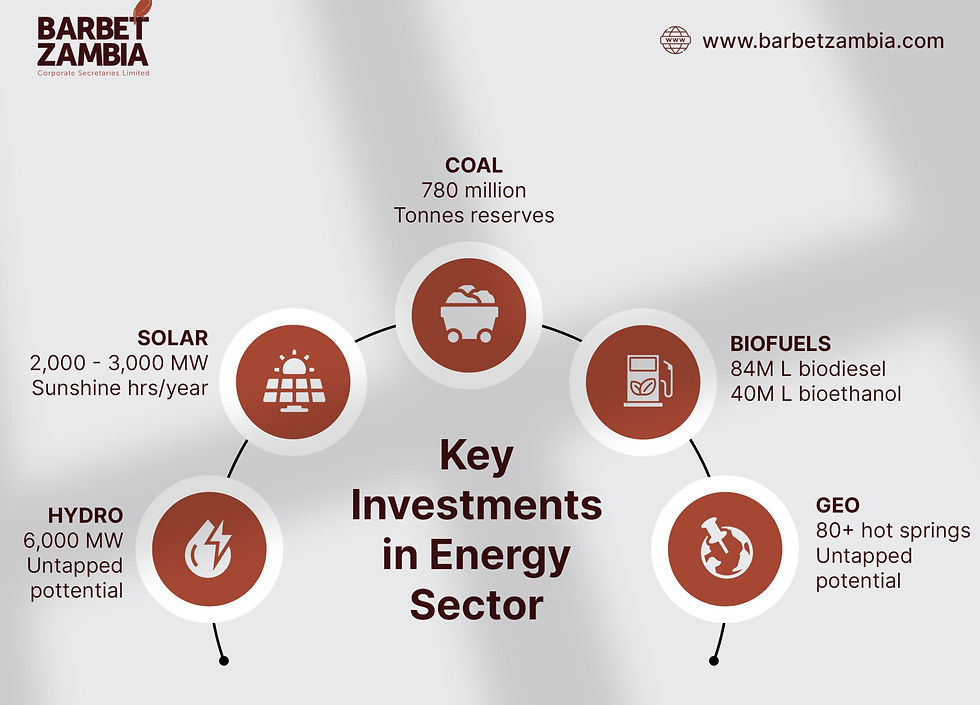
Other promising opportunities though less explored include biomass projects utilizing agricultural waste. This is the transmutation of agricultural byproducts such as crop stalks, husks, and animal manure into valuable electricity, heat, and renewable biofuels is a sustainable practice and reduces greenhouse gas emissions.
What makes Zambia particularly ripe for investment is its political stability and investor friendly regulator dynamics. These are critical considerations for infrastructure investments with decade-plus horizons. For entities willing to navigate the challenges of emerging market investment, Zambia's energy sector presents that rare combination of significant impact potential alongside compelling returns. As climate realities force a re-examination of the country's energy strategy, players positioned early are poised to benefit from what could become Africa's next major energy transformation story.
Are you considering exploring Zambia's energy sector landscape? Barbet Zambia offers comprehensive corporate secretarial services designed specifically for energy sector investors, including company formation, regulatory compliance management, and stakeholder engagement strategies. Our team of local experts can help navigate Zambia's investment landscape while ensuring alignment with the country's renewable energy incentive programs.
Contact us today to transform market opportunity into actionable investment strategy
+260 211 258 621


Comments